
Professional Clay Soil Bluff Stabilization Services on Lake Michigan
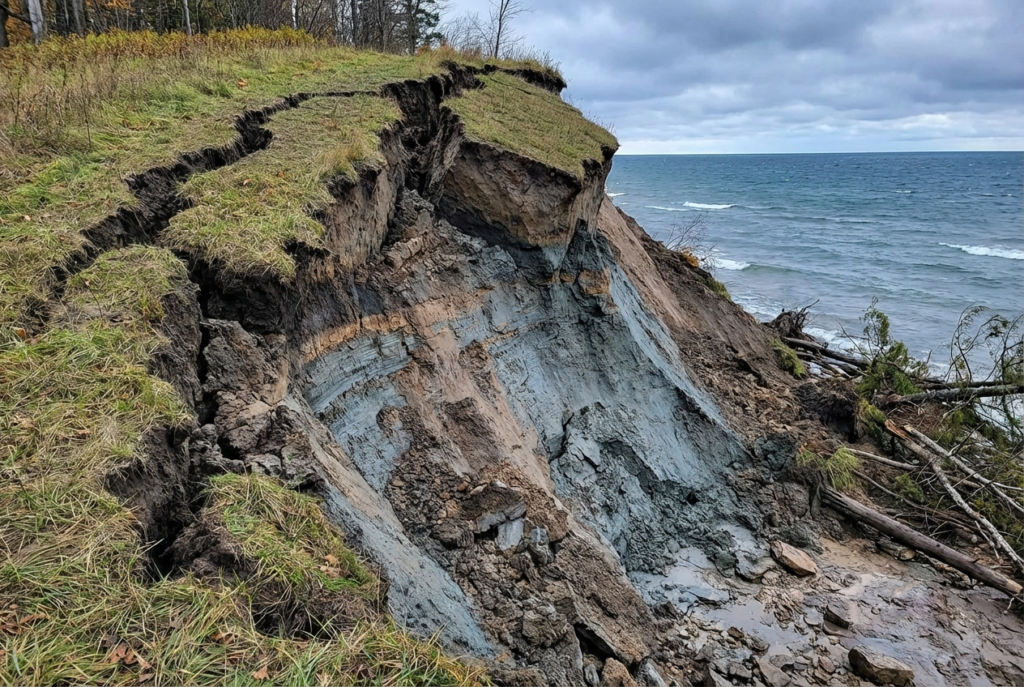
Clay soil doesn’t behave like other soils. It holds water longer, swells under saturation, and when it finally gives way on a bluff face it doesn’t erode gradually — it slips. Hard armoring like riprap can slow the process but it doesn’t solve the underlying problem, and on clay soil bluffs it often accelerates failure by redirecting pressure elsewhere. Clay soil bluff stabilization services on Lake Michigan requires a different approach — one built around how clay actually moves and what living systems can do that concrete can’t.
Stabilizing Lake Michigan Bluffs From the Ground Up
Why Clay Soil Fails Differently Than Other Bluff Terrain
Sandy and loamy soils erode predictably. Water moves through them, carries particles downslope, and the process is gradual enough that early intervention is straightforward. Clay soil on a Lake Michigan bluff doesn’t work that way. Clay absorbs water and holds it. The bluff face gets heavier as it saturates, increasing downslope pressure on the entire slope. When the clay finally releases it doesn’t crumble — it slips in mass movements that can take out large sections of bluff face in a single event.
The freeze-thaw cycle makes this worse. Water trapped inside clay expands when temperatures drop, pushing soil particles apart and reducing cohesion. By the time spring arrives, bluff faces that looked stable in October have measurably shifted. Each cycle loosens the structure a little more. On steeper bluffs or properties sitting close to the water line, there’s very little margin before that cumulative movement becomes a structural problem. Understanding this behavior is the starting point for any stabilization system that’s going to hold long-term on Lake Michigan clay soil terrain.
How Live Stakes and Fascines Anchor Unstable Slopes
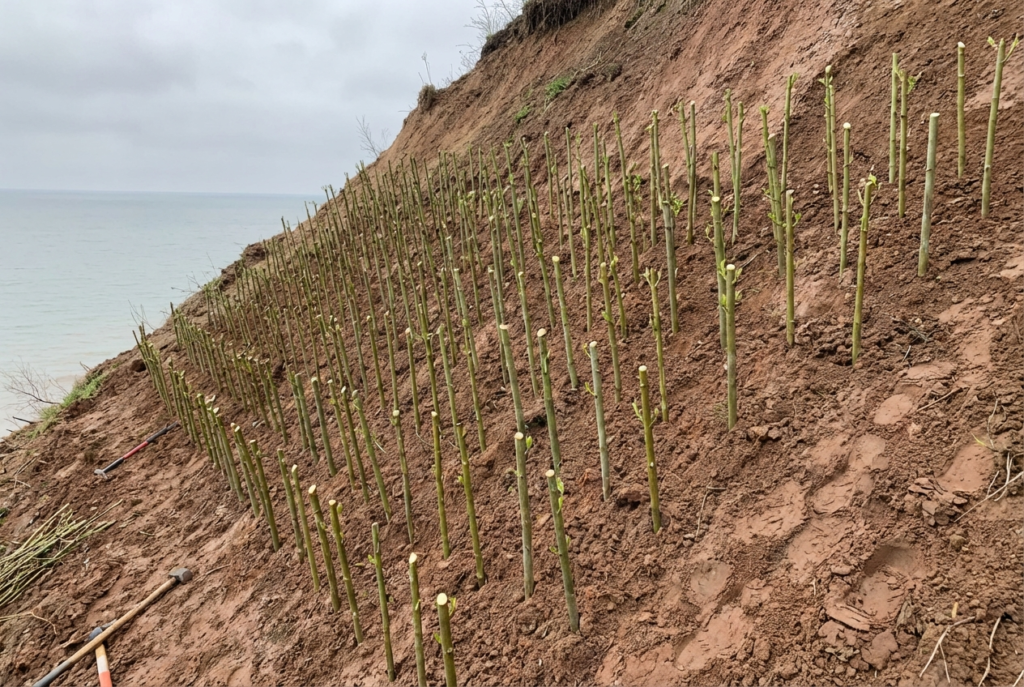
Live staking is one of the most effective tools for clay soil bluff stabilization because it works with the soil’s properties instead of against them. Willow and dogwood stakes driven directly into a clay soil slope take root quickly and begin pulling moisture out of the saturated layers that cause mass slippage. A single stake doesn’t do much. A grid of stakes planted at the right spacing and depth creates a root network that binds the clay layer and reduces the saturation cycles that trigger failure.
Live fascines work differently but complement the same goal. Bundled branches — typically willow — are trenched horizontally into the bluff face at intervals. As the fascines take root they create lateral reinforcement across the slope, interrupting the downslope movement of saturated clay. The combination of vertical stakes and horizontal fascines creates a three-dimensional root structure inside the bluff that no hard armoring system can replicate. On clay soil specifically, where water retention is the core problem, a living root system that actively manages moisture is more effective long-term than any barrier placed on top of the slope.
Brush Layering as a Reinforcement System
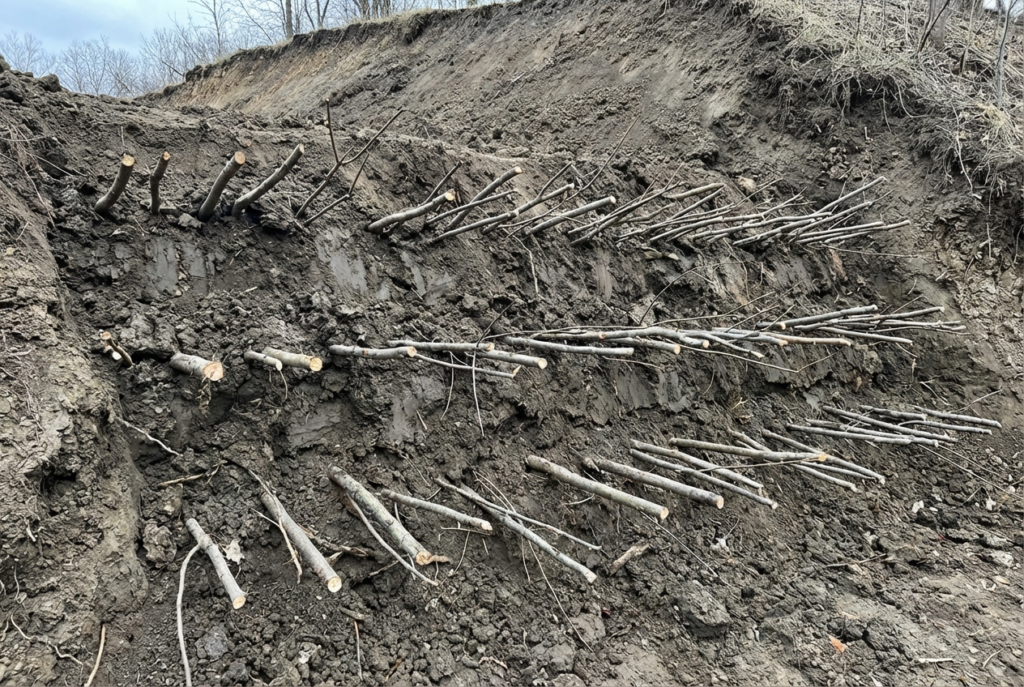
Brush layering involves placing cut branches between lifts of compacted soil on a slope face, with branch tips pointing outward and cut ends buried into the slope. As the branches root, they bind each soil layer to the next, creating a reinforced slope face that resists the kind of planar sliding common in saturated clay. The technique has been used in European river engineering for centuries and translates well to Lake Michigan bluff conditions where the clay soil layers are distinct and the failure mode is predominantly planar rather than surface erosion. The USDA NRCS Soil Bioengineering guidelines outline the technical standards behind these methods and why they outperform hard armoring on unstable slopes.
The materials are largely sourced on site or nearby. Willow, dogwood, and silky willow all root readily from cut branches and tolerate the wet conditions at the base of a Lake Michigan bluff. Brush layering is typically combined with live staking and fascines as part of a comprehensive bioengineered system rather than used in isolation. The layered approach means that even if one component takes longer to establish, the others are actively reinforcing the slope in the meantime. On a clay soil bluff where establishment conditions can be challenging, that redundancy matters.
Designing AGrayslake Michigan Wave Exposure
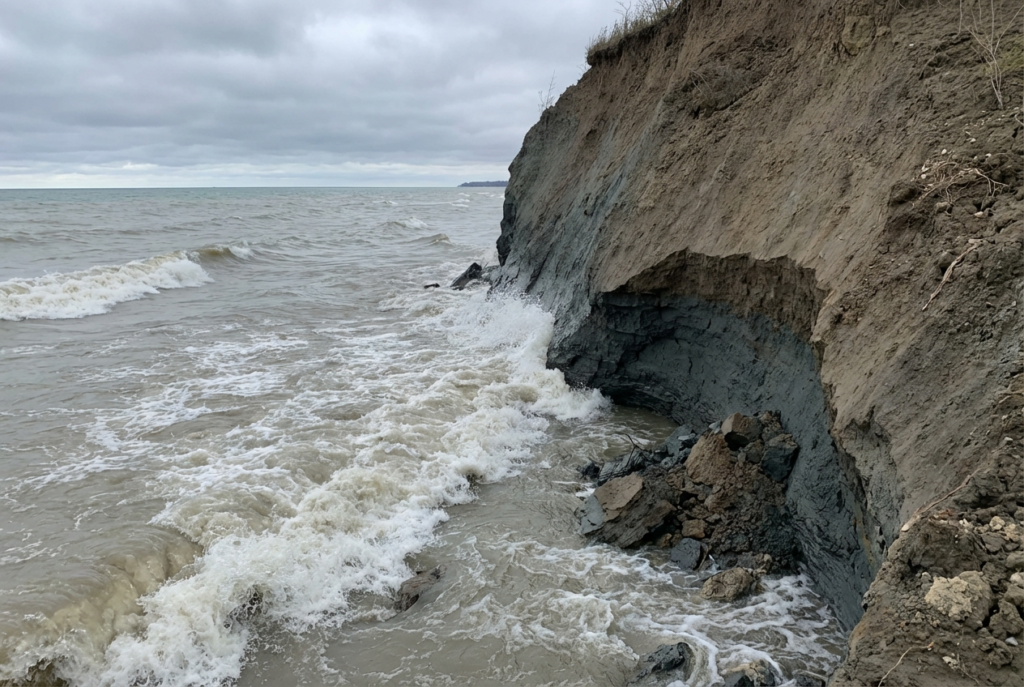
Lake Michigan generates significant wave energy. On exposed bluff properties without natural breakwater protection, wave action at the toe of the bluff is a constant destabilizing force regardless of what’s happening on the bluff face above. A bioengineered stabilization system that addresses the slope but ignores toe erosion will fail — the clay at the base will continue to undercut the slope and eventually compromise the root systems holding the face together.
Toe protection has to be designed into the system from the start. On some properties that means incorporating rock toe protection at the water line to absorb wave energy before it contacts the clay. On others, native emergent plantings in the shallow water zone can reduce wave energy enough to protect a bioengineered toe. The right approach depends on the property’s specific exposure, the depth of the water at the bluff base, and the seasonal wave patterns on that stretch of coastline. Designing a stabilization system without accounting for wave exposure at the toe is one of the most common mistakes made by contractors unfamiliar with Lake Michigan bluff dynamics.
Why Riprap Makes Clay Soil Problems Worse
Riprap is the default recommendation for bluff erosion on Lake Michigan. It’s what contractors know, it’s what suppliers stock, and it’s what gets quoted first. On sandy or mixed soil bluffs it can be effective. On clay soil bluffs it frequently accelerates the underlying problem. Riprap placed on a clay soil slope doesn’t bond to the substrate. The clay underneath continues its saturation and slippage cycles, and the riprap moves with it — or worse, the weight of the stone adds to the downslope pressure that’s already destabilizing the bluff.
Water that would have moved through a vegetated slope now gets redirected by the riprap and concentrated at specific points, often at the edges of the installation where it creates new erosion channels. Property owners who have already invested in riprap and are still watching their bluff fail are typically experiencing this exact dynamic. Removing riprap from a failing clay soil bluff and replacing it with a bioengineered system is more expensive upfront than the original installation but less expensive than watching the riprap and the bluff behind it continue to move toward the lake.
What the Installation Process Actually Looks Like
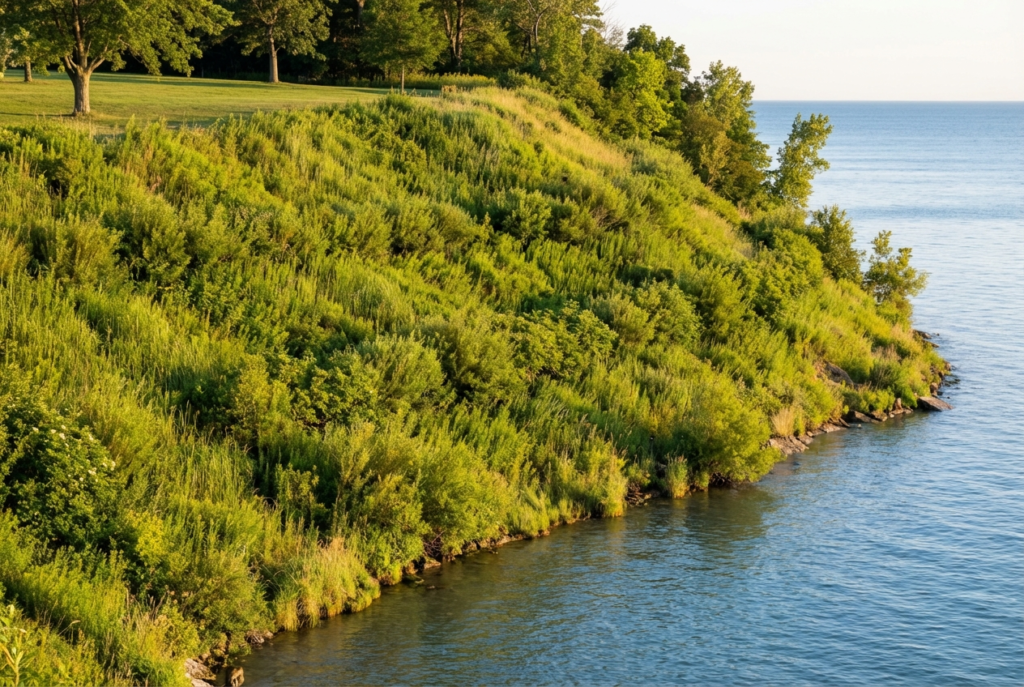
Bioengineered bluff stabilization doesn’t happen in a single site visit. The process starts with a slope assessment — documenting the failure patterns, the clay layer depth, the saturation zones, and the wave exposure at the toe. From that assessment a stabilization plan is developed that specifies the techniques, materials, spacing, and sequencing for the installation. On permitted properties the plan also has to satisfy IDNR and municipal steep slope requirements before any work begins.
Installation typically happens in phases. Toe protection goes in first if wave action is a factor. Brush layering and fascine installation follow, working up the slope from the base. Live staking goes in last, filling the grid across the treated area. Plant establishment takes one to three growing seasons before the root systems are developed enough to provide meaningful stabilization. During that period the installed materials provide structural reinforcement while the roots develop. Monitoring during the first two seasons is standard — checking stake survival rates, fascine rooting, and any new movement in the clay layers that might indicate the system needs adjustment. For properties moving through the Lake Michigan bluff permitting process, assessment documentation gathered during this phase feeds directly into the permit application.
The Contractor Who’s Never Worked Clay Soil Will Cost You Twice
Bioengineering contractors who learned their techniques on river banks and inland slopes show up on Lake Michigan bluff properties and apply the same methods. The spacing is wrong. The toe protection is an afterthought. The fascines are installed at the wrong angle for the slope grade. None of this is visible at the time of installation — everything looks fine until the first hard winter or the first significant wave event exposes the design flaws.
Clay soil bluff stabilization on Lake Michigan is a specific discipline. The saturation dynamics, the freeze-thaw behavior, the wave exposure at the toe, and the regulatory requirements for coastal work all require experience with this particular terrain. A contractor with a strong resume on inland erosion projects is not automatically qualified to work a Lake Michigan bluff. By the time the failure becomes obvious the window for a cost-effective fix has usually closed. The second installation — the one that actually works — costs significantly more than the first one would have if the right expertise had been involved from the start.
Timing a Bioengineered Installation Wrong Erases the First Season
Live stakes and fascines need to go in at the right time of year to root before summer heat and drought stress arrive. Installation too late in spring means the plant material is fighting to establish root systems during the most stressful conditions of the year. Survival rates drop, the spacing gaps that result leave sections of the bluff face unprotected, and the first season of establishment — which should be building the root network that holds everything together — is largely lost.
On clay soil bluffs where saturation and slippage are active problems, losing a full growing season of root development is not a minor setback. The clay continues its movement while the stabilization system struggles to establish. Early fall and early spring are the installation windows that give bioengineered systems the best chance of establishment on Lake Michigan bluff terrain. Getting the timing right is as important as getting the design right — and it requires planning the project well in advance of when the work actually needs to happen.
Plan Your Clay Soil Bluff Stabilization
Lake Michigan bluff properties with clay soil don’t get better on their own. If you’re seeing movement, cracking, or slumping on your bluff face, the window for a cost-effective bioengineered solution is open right now — but it won’t stay open indefinitely. David Eubanks has worked Lake Michigan bluff properties for over 30 years and understands the specific dynamics of clay soil stabilization on this coastline.
Call (847) 456-5604 to schedule an assessment to learn more about our Clay soil bluff stabilization services on Lake Michigan. Serving Lake Michigan coastal properties in Illinois and Wisconsin.