
Top Fire Pit Installation Services in Grayslake, IL
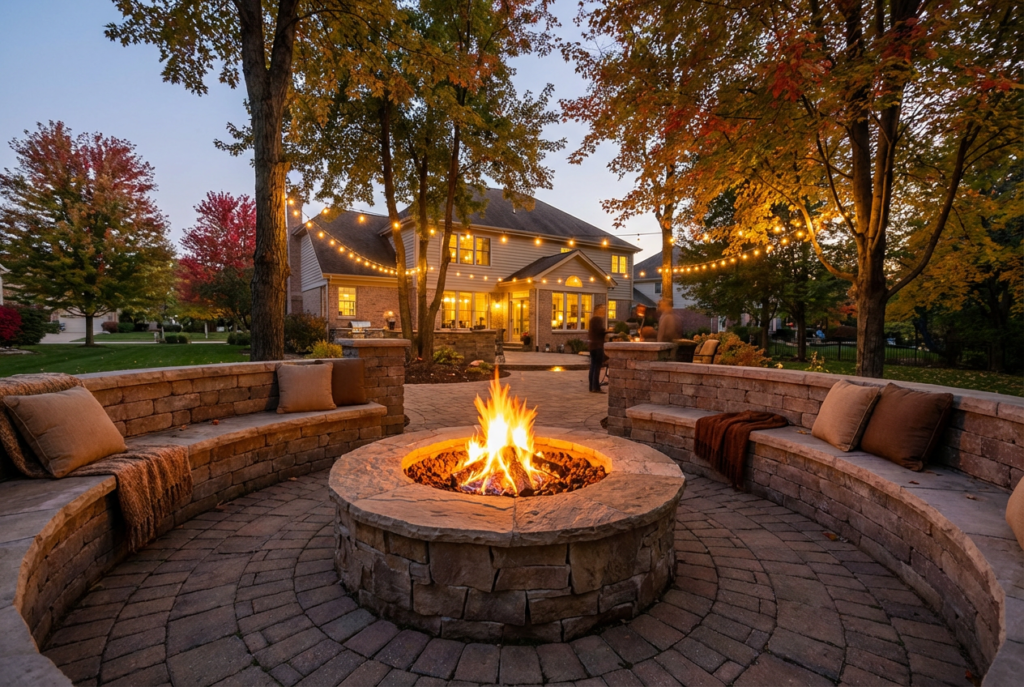
Fire pit installation services in Grayslake requires more planning than most homeowners expect — placement clearances, material selection that handles direct heat exposure, drainage underneath the base, gas line coordination for propane or natural gas features, and permit requirements that vary by municipality across Lake County. A fire pit installed without accounting for those details creates safety problems, fails prematurely, or gets flagged during a property sale as unpermitted work
We install wood burning and gas fire pits built to last through Lake County winters and perform safely through every season. That means proper base preparation in clay soil, heat-rated materials that don’t crack or deteriorate under direct flame exposure, correct placement relative to structures and property lines, and permit coordination handled before installation begins.
This page covers what goes into a fire pit installation done correctly in Grayslake — and what separates a feature that adds value from one that creates problems.
TLDR:
- Fire pit installation in Grayslake requires heat-rated materials, proper base prep in clay soil, and correct placement clearances
- Gas fire pits require line coordination and permits — wood burning fire pits have their own permit requirements in many Lake County municipalities
- Placement relative to structures, trees, and property lines determines safety and compliance
- Lake County clay soil and freeze-thaw cycles affect base preparation requirements just like any other hardscape
- Most fire pit projects integrate with existing or new patio installations for best results
Professional Fire Pit Installation Services in Grayslake
What Makes Fire Pit Installation Different From Other Hardscape
A patio is a surface. A fire pit is a heat source sitting on a surface — and that distinction changes almost everything about how it gets built. The materials around and beneath a fire pit have to handle direct flame exposure and radiant heat that patios, walkways, and retaining walls never experience. Standard concrete pavers crack under that kind of heat. Polymeric sand used in standard patio joints burns away. The base underneath has to drain perfectly because water trapped beneath a fire feature and then frozen creates movement that shifts the fire pit out of level and cracks the surround.
Placement adds another layer of complexity that patio installation doesn’t face. A patio can go almost anywhere in a backyard that makes functional sense. A fire pit has clearance requirements — minimum distances from structures, overhead trees, fences, and property lines that are determined by local fire codes and common sense. A fire pit installed too close to a wooden fence or overhanging branches is a liability, not a feature. Getting placement right requires knowing those clearances before anything gets built, not discovering them after installation.
Gas fire pits add coordination requirements that wood burning features don’t have. A gas line has to get to the fire pit — either natural gas from an existing line or propane from a tank that needs a permanent location. That coordination involves a licensed plumber or gas fitter, permit applications, and inspection before the feature can be used. Skipping that process creates an unpermitted gas installation that shows up as a problem during a home sale and represents a genuine safety risk.
None of these considerations are deal-breakers — they’re just details that have to be handled correctly before installation begins rather than figured out after problems appear.
Fire Pit Placement — What Determines Where It Goes
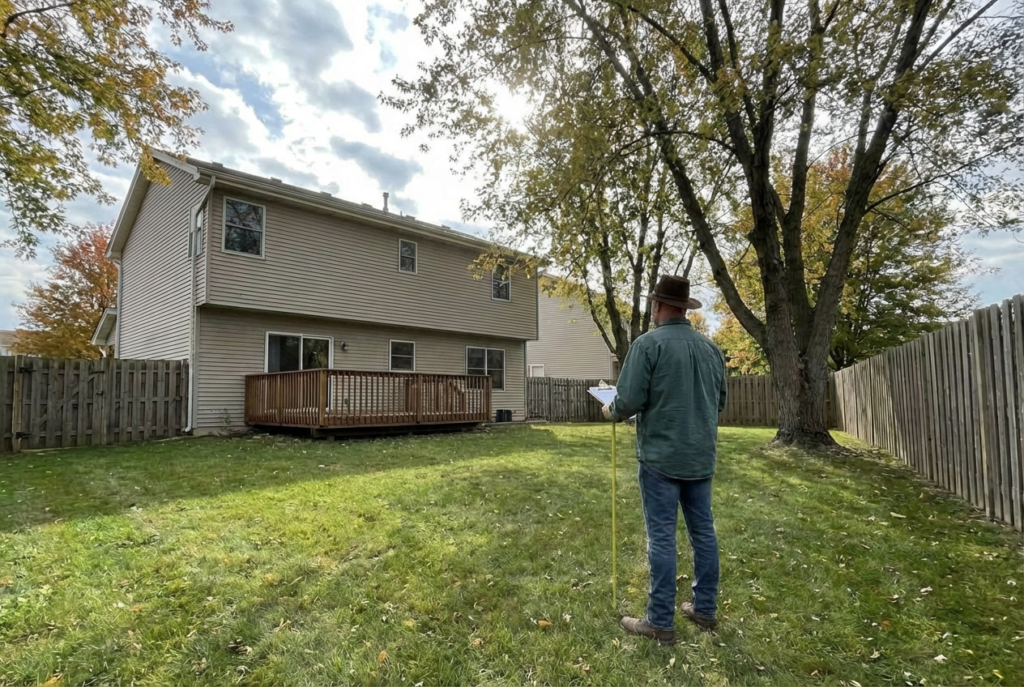
Placement is the first decision and the one that affects everything else. Get it wrong and the fire pit either creates a safety problem, violates local code, or ends up in a spot that makes it less usable than it should be. Get it right and everything downstream — base prep, drainage, gas line routing, integration with the patio — becomes straightforward.
Most Lake County municipalities follow the International Fire Code minimum clearance of 10 feet from any structure, fence, or combustible material. That includes wooden decks, vinyl fencing, overhanging tree branches, and neighboring structures. Some municipalities have stricter requirements. Grayslake, Lake Forest, Highland Park, and other Lake County communities each have their own ordinances governing open burning and permanent fire features — knowing which applies to your specific property before installation begins prevents the expensive problem of building something that has to move.
Wind patterns matter more than most homeowners think about during planning. A fire pit positioned where prevailing winds push smoke toward the house, toward a neighbor’s yard, or toward the primary seating area creates a feature nobody wants to use. Walking the property and understanding how wind moves through the specific site before committing to a location makes the difference between a fire pit that gets used constantly and one that sits empty because sitting near it is unpleasant.
Drainage underneath the fire pit location matters for the same reason it matters under a patio. Lake County clay soil holds water. A low spot that pools after rain creates a saturated base that freezes and shifts during winter. The fire pit surround cracks, goes out of level, and becomes both a cosmetic and functional problem. We assess drainage at the proposed location before installation and address it as part of the base preparation — not as an afterthought when the problem shows up after the first winter.
Integration with existing or planned patio space is the final placement consideration. A fire pit positioned as an isolated feature in the middle of a lawn is less functional than one integrated into a patio edge or connected to a seating area by a defined surface. The best fire pit installations feel like they were designed as part of the outdoor space — not dropped in as an afterthought.
Materials That Create a Fire Pit Worth Gathering Around
A fire pit is one of those rare outdoor features that changes behavior. Not just how a yard looks — how a family actually lives in it. The same people who spent every evening inside suddenly find reasons to be outside until the fire dies down. Neighbors who never got invited over show up on a Tuesday. Kids who would rather be on a screen are roasting marshmallows without being asked. That shift doesn’t happen because a fire pit got installed. It happens because the right fire pit got installed in the right spot with materials that make the whole space feel worth being in.
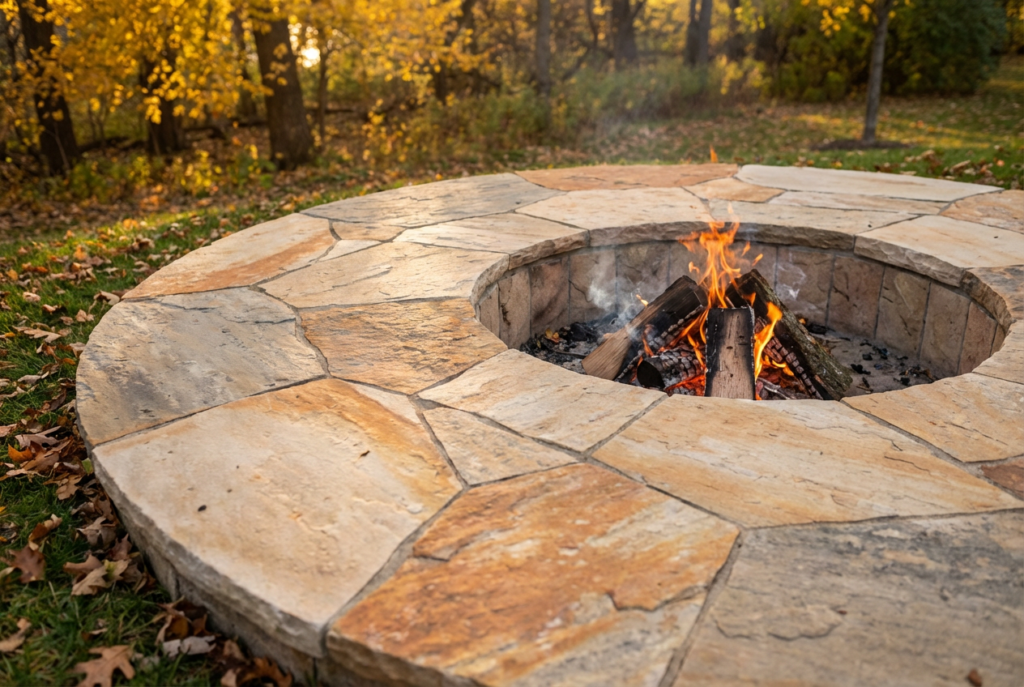
Natural flagstone surrounding a fire pit creates the look most people have in their head when they picture the perfect backyard fire. Irregular edges, warm earth tones, a surface that looks like it’s been there for decades even when it hasn’t. It’s the material that photographs beautifully in October light and looks even better in person. Tumbled concrete pavers give a cleaner, more defined appearance — the kind that integrates seamlessly with an existing patio and makes the whole outdoor space feel cohesive rather than pieced together. Dimensional cut stone takes it further — a polished, architectural look that makes people assume a designer was involved, even when the budget was straightforward.
Gas fire pits are their own category entirely. Glass media or lava rock over a hidden burner with a clean consistent flame looks like something out of a home design magazine. No ash cleanup, no wood storage, no waiting for it to catch — just turn it on and it’s ready. The flame is beautiful in a different way than a wood fire. More sculptural. More controlled. For homeowners who entertain regularly and want ambiance without the management, gas is the obvious call.
For homeowners who want the real thing — the crackle, the smell, the ritual of building a fire and watching it develop — nothing replicates a wood burning fire and nothing should try to. That experience is specifically why people gather around fires. It’s primal in a way that a gas flame, for all its beauty, isn’t quite.
The seating area around the fire pit is where the installation either comes together or falls apart. A fire pit dropped into a lawn with folding chairs pulled up around it is functional. A fire pit integrated into a defined patio space with a built-in sitting wall, a level surface underfoot, and low lighting that makes the whole area glow after dark is something people talk about. The best fire pit installations don’t just install the feature — they create the environment around it that makes people want to stay outside until midnight on a Wednesday in October.
Wood Burning vs Gas — Which One Is Right for Your Property
This is the question most homeowners are already asking before they call anyone. The answer depends less on which one looks better and more on how you actually want to use it.
Wood burning fire pits are the classic choice for a reason. The experience is irreplaceable — the sound of crackling wood, the smell that gets into your clothes and somehow nobody minds, the ritual of building the fire and watching it grow. Wood fires move. They breathe. They require something from you and give something back that a gas flame doesn’t quite replicate. For families who want the full campfire experience in their backyard, wood burning is the obvious answer.
The tradeoff is management. Wood needs to be stored somewhere dry and accessible. The fire takes time to build and time to die down before you can leave it. Ash needs to be cleaned out periodically. Embers can travel on wind — which is why placement relative to the house, fencing, and overhanging trees matters more with wood burning than gas. None of these are dealbreakers for most people. They’re just part of the experience.
Gas fire pits flip that equation. The fire is ready in thirty seconds. It turns off completely when you’re done. No ash, no embers, no wood storage. Hosting a dinner party on a Thursday night where the fire is one element of the evening rather than the whole event — gas makes that effortless. The flame is consistent and beautiful in a way that’s different from a wood fire but genuinely appealing in its own right.
The tradeoff with gas is the connection. Natural gas requires a licensed plumber to run a line from the house — that’s a permit, a coordination step, and an upfront cost that wood burning doesn’t have. Propane eliminates the line but requires a tank somewhere on the property. Neither is complicated. Both just require planning before installation begins rather than after.
Grayslake and Lake County municipalities have specific requirements for both. Open burning ordinances govern wood fire pits — some municipalities restrict them entirely during certain conditions. Gas installations require permits and inspection before use. Knowing what applies to your specific property before choosing a fuel type saves the frustration of building something that creates a compliance problem later. We handle tlhat coordination as part of every installation so you don’t have to navigate it yourself.
Fire Pit Designs That Actually Get Used
The fire pits that become the center of outdoor life have one thing in common — they were designed around how the space actually gets used, not just how they look in a portfolio photo. A beautiful fire pit that’s awkward to sit around, too far from the house to use casually, or surrounded by surfaces that make it feel disconnected from the rest of the yard is a feature that gets used a few times and then mostly sits there.
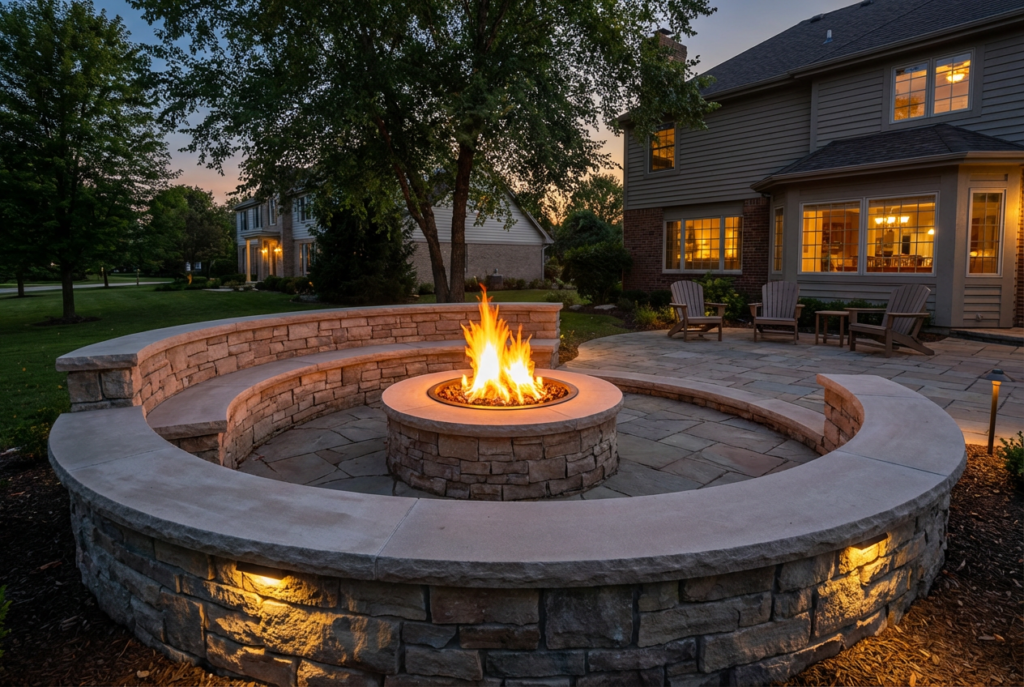
The sitting wall is the single upgrade that most changes how a fire pit gets used. A built-in sitting wall around the fire pit perimeter creates defined seating that feels permanent and intentional. No dragging chairs out from the garage, no lawn chairs sinking into grass around the edges, no figuring out where people should sit. The wall is there, it’s comfortable with cushions, and it immediately signals to anyone walking into the backyard that this is a place worth gathering. Sitting walls also solve the practical problem of where guests sit when the folding chairs run out — a 20-foot curved sitting wall seats eight people comfortably without a single piece of furniture.
Lighting is what transforms a fire pit space from a daytime feature to an all-season destination. Low voltage lighting integrated into a sitting wall, path lighting leading from the house to the fire pit, or string lights overhead creates an atmosphere after dark that makes the space feel like a destination rather than a corner of the yard. Fire lit, low lights on, the rest of the yard dark — that’s the setup that keeps people outside until midnight on a Wednesday in October.
Integrating the fire pit with the existing or new patio is what makes the whole outdoor space feel cohesive rather than pieced together. A fire pit zone that flows naturally from a patio — defined by a sitting wall, connected by a paver surface, oriented toward the best view of the yard — feels designed. A fire pit dropped into grass twenty feet from the back door feels like an afterthought. The difference in how much it gets used is significant.
Table top fire features, linear gas burners built into a sitting wall, and sunken fire pit designs are all options that work well on Lake County properties where the right design makes the space. The best conversation we have with every homeowner considering a fire pit is not about materials or permits — it’s about how they picture themselves using the space on a Thursday evening in September. That answer determines everything else.
What a Fire Pit Installation Looks Like in Grayslake
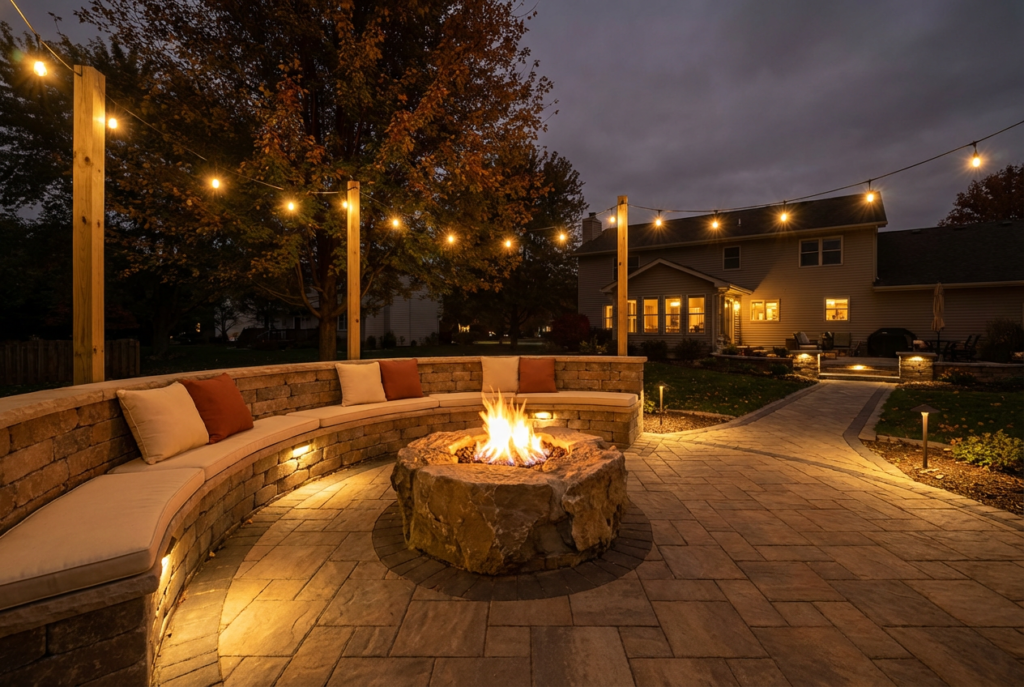
Most fire pit projects in Grayslake fall into one of two categories — a standalone fire pit integrated into an existing patio, or a new fire pit area built as part of a larger outdoor living project that includes patio, seating wall, and lighting together.
The standalone integration is the most common starting point. A homeowner already has a patio — maybe one we installed, maybe one that was there when they bought the house — and wants to add a fire feature to make the space more usable in the evenings and extend the outdoor season into October and November. The fire pit gets designed to work with the existing surface, sitting wall if budget allows, and gas or wood burning depending on how they want to use it. Most of these projects take two to three days from start to finish and transform a patio that was used occasionally into one that gets used constantly.
The full outdoor living project is where the results are most dramatic. Starting from scratch — or rebuilding an outdoor space that wasn’t working — allows the fire pit, patio, sitting wall, lighting, and landscaping to be designed together as a cohesive system. The fire pit zone becomes the anchor of the outdoor space. Everything else is oriented around it. The result is an outdoor room that feels as intentional and complete as any room inside the house — and in Lake County summers and falls, gets used just as much.
Both approaches start the same way. A site visit to walk the property, understand how the space gets used, discuss fuel type and design preferences, and identify any permit requirements for the specific municipality. From there a plan gets developed, materials get selected, and installation happens in the right sequence — base preparation, gas line coordination if needed, fire pit installation, sitting wall if included, lighting last.
The fire pit installations that get used the most are the ones where that first conversation was honest about how the space actually gets used — not just what looks good. A fire pit designed around Thursday evenings with a few close friends is different from one designed around large summer gatherings. Both are achievable. Getting the design right starts with understanding which one you’re building toward.
If you’re ready to add a fire pit to your Grayslake property, let’s start with that conversation before anything else gets decided. Call (847) 456-5604 for fire pit installation in Grayslake. Serving Lake County, northern Illinois, and southern Wisconsin.