
Expert Lake Michigan Bluff Permitting Services
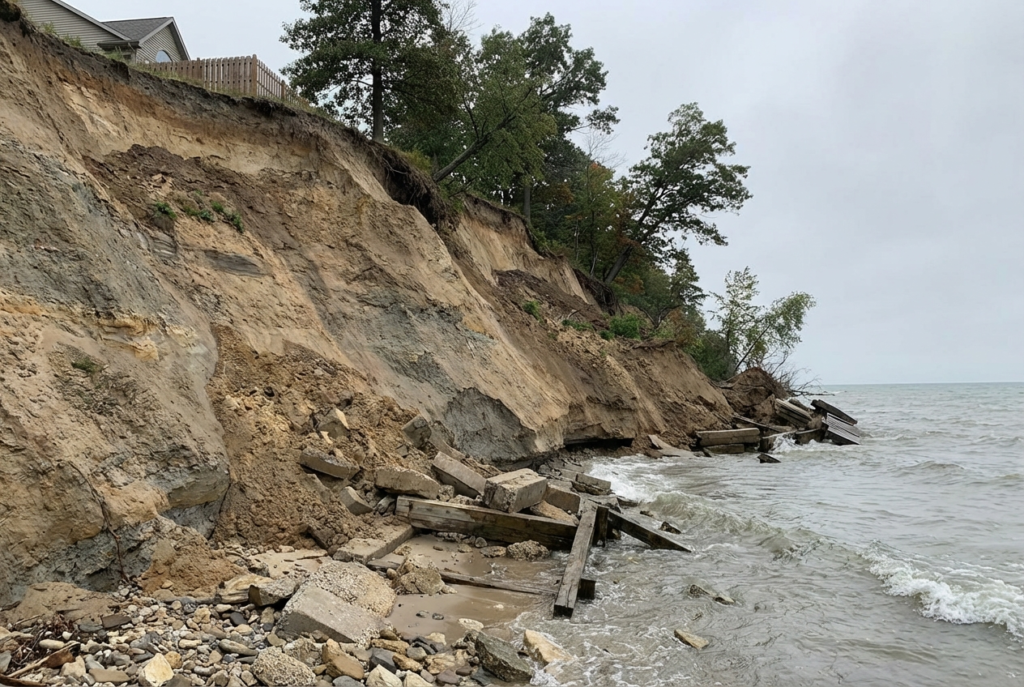
Lake Michigan Bluff Permitting Services involves three separate government agencies with overlapping jurisdiction and conflicting requirements. IDNR regulates shoreline work below the Ordinary High Water Mark. Army Corps of Engineers controls any fill or structures in navigable waters. Municipal steep slope ordinances regulate grading and construction on slopes exceeding certain grades. Each agency reviews applications independently using different criteria and timelines. Getting approval from one agency doesn’t guarantee approval from the others. Most bluff restoration projects require coordinated permits from all three before work can begin.
Understanding Lake Michigan Bluff Permitting Services
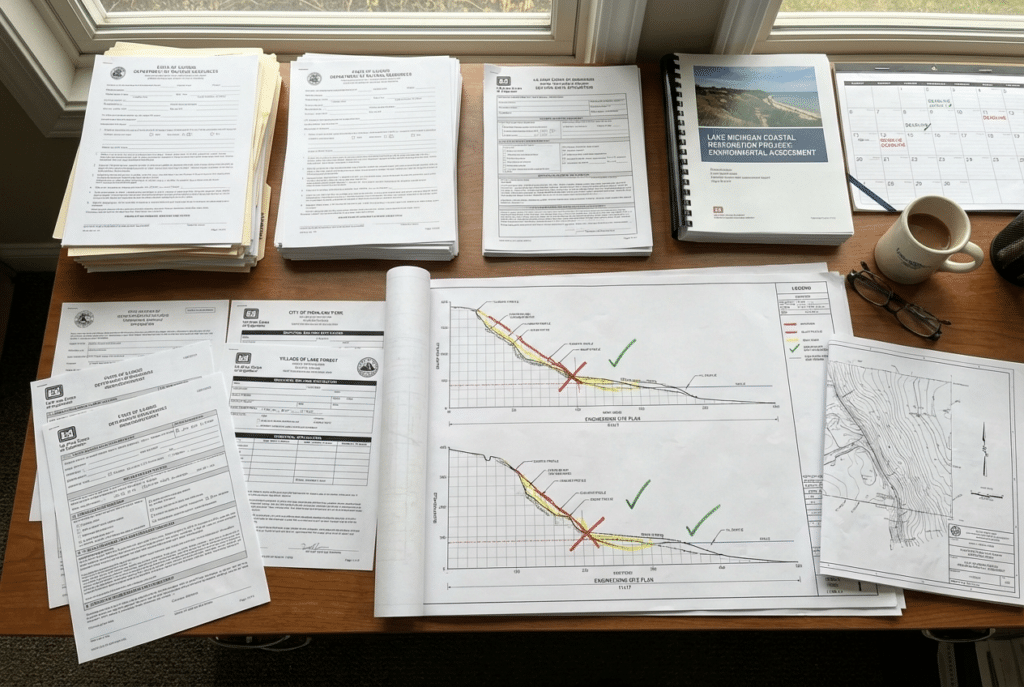
IDNR Jurisdiction Below the Ordinary High Water Mark
Illinois Department of Natural Resources regulates all work below the Ordinary High Water Mark on Lake Michigan. This includes shoreline stabilization, beach access, toe protection, and any structures touching water. The Ordinary High Water Mark sits at 581.5 feet above sea level for Lake Michigan. Most bluff restoration involves some work at or below this elevation where waves attack the bluff base. IDNR reviews projects for environmental impact, public access, and compliance with Illinois Coastal Management Program. Application requires detailed site plans showing existing conditions, proposed work, construction methods, and environmental protection measures. IDNR consultation with other agencies including Army Corps and Illinois Environmental Protection Agency adds months to review timelines. Projects affecting threatened or endangered species habitat face additional scrutiny and possible denials. Seasonal restrictions prohibit certain work during fish spawning or migratory bird nesting periods. Our Lake Michigan bluff restoration planning includes IDNR permit preparation addressing all regulatory requirements before submission.
Army Corps Section 404 and Section 10 Permits
US Army Corps of Engineers regulates work in navigable waters under Section 10 of the Rivers and Harbors Act and Section 404 of the Clean Water Act. Any fill material placed below the Ordinary High Water Mark requires Section 404 permit. Any structure or work affecting navigation requires Section 10 permit. Most bluff toe protection using riprap or sheet piling triggers both permit requirements. Army Corps distinguishes between individual permits for major projects and nationwide permits for smaller standard projects. Individual permits require extensive environmental review including alternatives analysis and public notice period. Nationwide permits have pre-approved conditions but still need verification review. Determining which permit type applies requires understanding project scope and environmental impacts. Wrong permit category causes denials and restart of entire process. Army Corps coordinates with US Fish and Wildlife Service, EPA, and state agencies before issuing permits. Federal review timelines range from 60 days for simple nationwide permits to 18+ months for complex individual permits requiring environmental impact statements.
Municipal Steep Slope Ordinances and Building Permits
North Shore municipalities regulate work on steep slopes through local ordinances independent of state and federal permits. Highland Park defines steep slopes as grades exceeding 12%. Lake Forest uses 15% grade threshold. Winnetka has different standards for lakefront versus inland properties. Each municipality prohibits grading, vegetation removal, or construction on designated steep slopes without special permits. Applications require engineered grading plans, erosion control details, vegetation management plans, and sometimes geological assessments. Public hearings may be required for work visible from neighboring properties. Some ordinances mandate specific construction techniques or materials. Others restrict work to certain times of year avoiding wet seasons. Municipal permits typically process faster than state or federal permits but have stricter aesthetic requirements. Denials at the municipal level stop projects before state or federal review even begins. Our environmental planning for bluff projects navigates municipal requirements while preparing state and federal applications simultaneously.
Coordinating Overlapping Agency Requirements
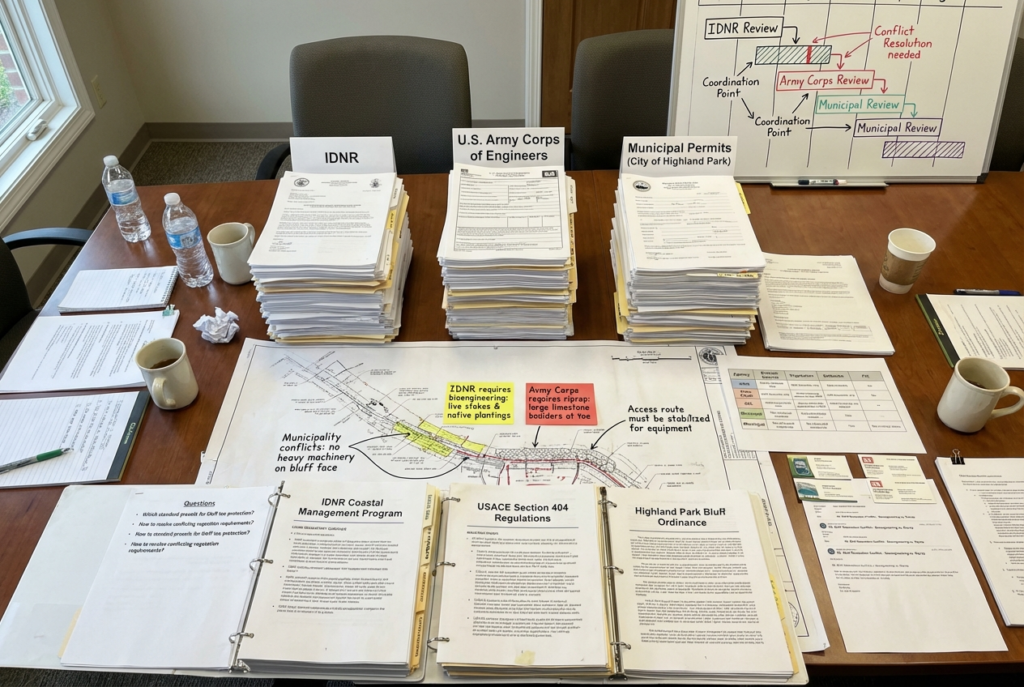
Three agencies reviewing the same project creates contradictory requirements that must be reconciled before approval. IDNR may approve bioengineering approaches while Army Corps requires hard armoring for navigable water protection. Municipal aesthetic standards prohibit visible riprap while federal permits require it for erosion control. Environmental agency restrictions on work timing conflict with construction season limitations and weather windows. Getting agencies to coordinate directly rarely happens. Applicant bears responsibility for satisfying everyone simultaneously. This requires understanding each agency’s priorities and designing solutions meeting all requirements without contradictions. Sometimes this means submitting modified plans back through multiple review cycles. Other times it requires formal inter-agency consultation forcing agencies to resolve conflicts before project approval. Successful permit coordination requires predicting conflicts and addressing them proactively in initial applications rather than discovering problems after denials. According to the US Army Corps regulatory guidance, coordinated review reduces overall timelines but requires careful upfront planning and agency communication.
Understanding Application Review Timelines
Permit timelines vary dramatically based on project complexity and agency workloads. Simple municipal steep slope permits may approve in 30-60 days. IDNR reviews take 90-180 days for standard projects. Army Corps nationwide permit verifications take 60-90 days. Individual Army Corps permits require 12-24 months. These are ideal timelines assuming complete applications with no deficiencies. Incomplete applications restart timelines from zero after rejection. Agency requests for additional information pause review until responses submitted. Public comment periods add 30-45 days. Environmental assessments add months. Coordination between agencies adds unpredictable delays. Winter weather closes review offices reducing effective processing time. Meanwhile bluffs continue eroding 2-5 feet per year during permit reviews. Property owners watch bluffs fail while waiting for permission to stabilize them. Some homeowners lose 20-30 feet of bluff during multi-year permit processes. Emergency permits exist for imminent structure threats but require proving immediate danger and accepting limited scope approvals.
Environmental Review and Mitigation Requirements
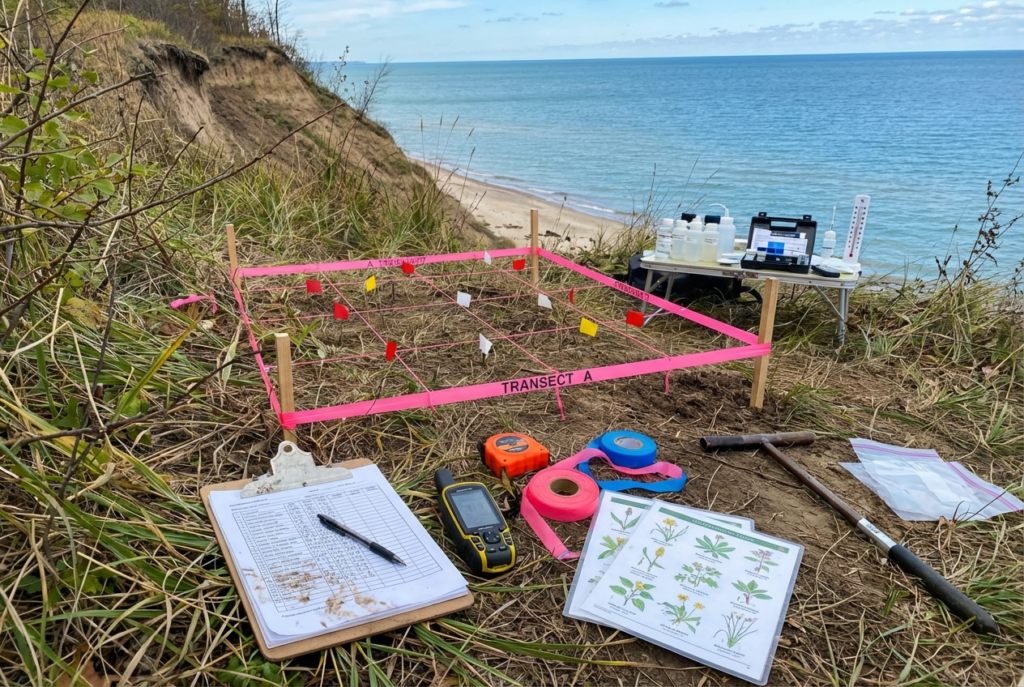
Permits require environmental assessments documenting existing conditions and project impacts. Wetland delineations identify jurisdictional waters even if obvious. Threatened and endangered species surveys check for plovers, terns, or rare plants. Cultural resource reviews search for archaeological or historical sites. Water quality impact statements predict sediment and pollution effects. Each assessment requires qualified professionals and field investigations during specific seasons. Missing survey windows delays projects entire years waiting for next field season. Identified impacts require mitigation plans offsetting environmental damage. Destroying 100 square feet of beach habitat may require creating 200 square feet elsewhere. Impacting rare species habitat triggers consultation processes adding months to reviews. Some impacts cannot be mitigated resulting in permit denials regardless of property owner needs. Projects near public beaches face additional scrutiny for public access and recreational impacts. Environmental compliance costs often exceed actual construction costs for complex bluff projects. Wetland delineations cost $2,000-$5,000. Endangered species surveys run $3,000-$8,000 depending on site size and required observation periods. Cultural resource assessments add another $4,000-$7,000. These costs occur before construction even begins and provide no guarantee of permit approval.
Planning for Permit Compliance and Monitoring
Permits include conditions requiring specific construction methods, timing restrictions, and post-construction monitoring. Work must follow approved plans exactly. Changes during construction require permit modifications restarting review processes. Environmental monitors may be required on-site during construction documenting compliance. Erosion control measures must be installed before any ground disturbance. Sediment barriers prevent construction debris reaching Lake Michigan. Seasonal restrictions limit work to specific months avoiding sensitive wildlife periods. Providing bluff restoration permits for Lake Michigan properties includes compliance planning ensuring contractors understand permit conditions and construction proceeds without violations triggering stop-work orders or fines.
Consultants Promise Permits They Can’t Deliver
Engineering firms tell property owners “we’ll handle all the permits” then submit applications that get denied repeatedly. They understand municipal building permits but have zero experience with IDNR or Army Corps processes. Applications miss critical environmental documentation. They propose techniques that violate federal regulations. They ignore seasonal restrictions making timelines impossible. After three denials and $25,000 in application fees, property owner discovers the consultant never actually secured a coastal permit before. Meanwhile bluff erodes another 15 feet and now the project scope has changed requiring completely new applications. Permit experience matters more than engineering credentials for Lake Michigan work. Generic environmental consultants who occasionally do coastal projects fail catastrophically compared to specialists who work exclusively on bluff permitting. We’ve rescued dozens of projects after consultants abandoned clients following permit denials they should have anticipated before charging for applications.
One Missing Document Restarts Everything

Permit applications require dozens of supporting documents. Wetland delineation reports. Endangered species surveys. Erosion control plans. Construction sequencing. Environmental impact assessments. Cultural resource reviews. Miss one document and application gets rejected as incomplete. No review happens. No feedback provided. Just rejection letter saying resubmit when complete. Some agencies charge new application fees for resubmissions. Others restart review timelines from day one. Property owner thinks application is under review for four months. Then gets rejection letter saying it never entered review because soil boring report was missing. Another four months minimum before review actually begins. Applications submitted in spring get rejected in fall. Now winter weather prevents field work for missing surveys. Next submission window is following spring. One-year delay from single missing document that could have been obtained in two weeks if anyone had mentioned it upfront. Complete application checklists prevent these disasters but most consultants use generic templates missing Lake Michigan-specific requirements.
Plan Your Bluff Restoration Permits
We can prepare complete permit applications addressing IDNR, Army Corps, and municipal requirements simultaneously while coordinating agency review to minimize timelines and contradictions.
Call (847) 456-5604 for Lake Michigan bluff restoration permit planning.